
Your data on MRCVSonline
The nature of the services provided by Vision Media means that we might obtain certain information about you.
Please read our Data Protection and Privacy Policy for details.

In addition, (with your consent) some parts of our website may store a 'cookie' in your browser for the purposes of
functionality or performance monitoring.
Click here to manage your settings.
If you would like to forward this story on to a friend, simply fill in the form below and click send.

Your friend's email:
Your email:
Your name:
 
 
Send Cancel

Winter arrives with ‘swanfall’ at Slimbridge
"We now have over 70 here, with more arriving each day." - Steve Heaven, swan research assistant.

Arrival spurred on by drop in temperature

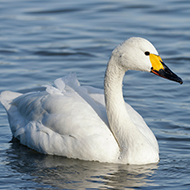
More than 50 Bewick’s swans have arrived at the Wildfowl and Wetlands Trust (WWT) in Slimbridge, Gloucestershire. This marks the end of the swan’s 4,000km migration, and traditionally signifies the start of winter.

The arrival of such a large number of swans at once is known as a ‘swanfall’. With this year’s taking place more than five weeks after the arrival of the first Bewick’s of the season, Gastro and Roux, who flew in on 27 October.

The Bewick’s hail from Arctic Russia. Migrating to the UK for the comparatively warmer climate and ice-free wetlands.

Swan research assistant Steve Heaven said: “The arrival of the first ‘swanfall’ is always a fantastic spectacle, and we now have over 70 here, with more arriving each day.

“We are still on the lookout for some of our regulars, including Croupier, who has been a favourite of visitors here at Slimbridge for almost three decades.

We’re anxiously keeping our fingers crossed that he might still arrive, but in the meantime, we’re delighted to see his son, Croupie, back on the pond, along with his mate, Wheel.”

WWT staff identify and record individual swans using the unique black and yellow beak markings of every new arrival. Giving names to first-time visitors and monitoring families.

More than 10,000 swans have been recorded in the 50 years that this process has been being conducted. WWT continues to use this data in their research and conservation efforts.


Become a member or log in to add this story to your CPD history

Equine Disease Surveillance report released for Q4 2025

News Story 1
 The latest Equine Disease Surveillance report has been released, with details on equine disease from Q4 of 2025.

The report, produced by Equine Infectious Disease Surveillance, includes advice on rule changes for equine influenza vaccination.

Statistics and maps detail recent outbreaks of equine herpes virus, equine influenza, equine strangles and equine grass sickness. A series of laboratory reports provides data on virology, bacteriology, parasitology and toxicosis.

This issue also features a case study of orthoflavivus-associated neurological disease in a horse in the UK. 

Click here for more...
News Shorts
RCVS annual renewal fee for vets due

RCVS' annual renewal fee for veterinary surgeons is now due. Vets must pay their renewal fee before Wednesday, 1 April 2026.

This year's standard annual fee has increased to 431 from last year's 418. This is an approximately three per cent increase, as approved by RCVS Council and the Privy Council.

Tshidi Gardner, RCVS treasurer, said: "The small fee increase will be used to help deliver both our everyday activities and our new ambitious Strategic Plan, which includes aims such as achieving new legislation, reviewing the Codes of Professional Conduct and supporting guidance, and continuing to support the professions through activities such as the Mind Matters Initiative, RCVS Academy and career development."

A full breakdown of the new fees is on the RCVS website. Information about tax relief is available on the UK government website.

