


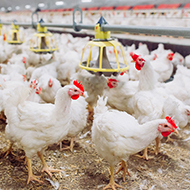
Thousands of birds to be humanely culled.
Thirteen-thousand birds will be culled at a broiler farm in Cheshire after confirmation of an outbreak of avian influenza.
The outbreak strain was confirmed by the Animal and Plant Health Agency (APHA) on Tuesday evening (3 November) as highly pathogenic H5N8 related to the virus currently circulating in Europe.
All 13,000 birds at the farm near Frodsham will be humanely culled to limit the spread of the disease. Temporary control zones of 3km and 10km have been placed around the premises to reduce the risk of the disease spreading.
The confirmation comes after a case of low pathogenic H5N2 avian flu was also confirmed on Monday (2 November) at a small farm in Kent.
Chief Veterinary Officer, Christine Middlemiss, said: “Avian flu has been confirmed at a commercial farm near Frodsham in Cheshire. Immediate steps have been taken to limit the risk of the disease spreading and all remaining poultry at the farm will be culled.
“Public Health England has confirmed that the risk to public health is very low and the Food Standards Agency advises that bird flu poses a very low food safety risk for UK consumers. Bird keepers should remain alert for any signs of disease, report suspected disease immediately and ensure they are maintaining good biosecurity on their premises.
“We are urgently looking for any evidence of disease spread associated with this farm to control and eliminate it.”
Dr Gavin Dabrera, a consultant in acute respiratory infections at Public Health England, said: “There have never been any confirmed cases of H5N8 in humans and the risk to public health is considered very low. We continue to work closely with Defra throughout this investigation."
A Food Standards Agency spokesperson said: “We advise that, on the basis of the current scientific evidence, avian influenzas pose a very low food safety risk for UK consumers. Properly cooked poultry and poultry products, including eggs, remain safe to eat.”
This story was updated on 5 November 2020 to confirm that the H5N8 strain is highly pathogenic.


 Eligible members of BEVA will be able to vote for their Council team until Monday, 17 August 2026. Members will have received an election email on 17 July.



