


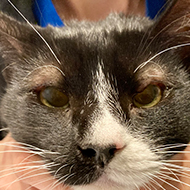
Novel procedure is less invasive compared to surgery.
An innovative vet from Cheshire has successfully used a cosmetic procedure for humans to treat a cat with abnormal eyelids.
Natasha Carr-Sycheva from Eye Vet Referrals used human lip filler in place of reconstructive surgery to help a cat diagnosed with bilateral upper eyelid agenesis.
The two-year-old cat, named Oreo, was born with the congenital condition, which causes the eyelashes to rub against the eye surface.
The most challenging aspect of the case was the extent of the agenesis. Three-quarters of the upper eyelid had not formed, and surgical repair would have required extensive skin grafting to repair.
After discussing the various surgical options with Oreo’s owner, it was agreed that Natasha would pursue the alternative solution of using hyaluronic acid filler injections.
“These fillers are actually used in human aesthetic lip enhancement, but we were confident they could also be used in this different way to help Oreo,” Natasha explained. “The benefits of the injections are that they’re quicker, minimally invasive, only require sedation, not a general anaesthetic, and recovery is shorter and less painful.
"There’s also an immediate beneficial effect with this technique, and once the patient has recovered from the sedation there is usually no further recovery period required.”
After sedating Oreo, Natasha and her team used surgical operating loupes to magnify his eyelids. The loupes enabled them to ensure the filler was injected into the correct position to direct the hairs away from the eye surface.
“When we heard about this ground-breaking treatment from Natasha and Eye Vet, we thought it was such a great idea,” said Oreo’s owner, Joanne Salomon. “It’s a much less invasive procedure compared to an operation, and without all the trauma and risks associated with surgery, so we were keen to try it.
“We’re very pleased with the results. Oreo certainly seems happier, he has come out of himself more and is a lot more playful, which is all wonderful to see. We’re also now able to tell everyone that our cat’s had cosmetic surgery – and how many people can say that!”
Image (C) Eye Vet Referrals.


 Defra has published guidance for the vet sector ahead of a proposed UK-EU Sanitary and Phytosanitary agreement.



