


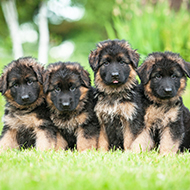
Test predicts the risk of congenital idiopathic megaesophagus with 75 per cent accuracy.
Researchers in the US have developed a genetic test for an often-fatal osophageal disorder of German shepherd dogs.
German shepherds are prone to an inherited condition called congenital idiopathic megaesophagus (CIM), in which a puppy develops an enlarged oesophagus making it difficult to pass food into the stomach. The condition causes regurgitation and failure to thrive in puppies shortly after weaning.
While German shepherds are predisposed to CIM, Labrador retrievers, dachshunds, Great Danes, and miniature schnauzers are also prone to the disease. However, scientists do not yet understand whether the same genetic variation is involved.
In the study, researchers at Clemson University, South Carolina, performed a genome-wide scan to identify genes associated with the disorder.
The scan revealed an association on canine chromosome 12 and a variant within melanin-concentrating hormone receptor two (MCHR2) that affects appetite, weight and how food moves through the gastrointestinal tract. The team believes that an imbalance of melanin-concentrating hormones plays a role in CIM.
Researchers also discovered that male puppies are twice as likely to be affected by CIM than females. This finding suggests that higher estrogen levels allow food to pass to the stomach more effectively, thus protecting against disease development.
“What they’ve found in people is that estrogen has the effect of relaxing the sphincter that connects the esophagus to the stomach,” commented Sarah Bell, a graduate research assistant in genetics and the first author of the study.
“By having more estrogen, the smooth muscle there is naturally more likely to open. This increases the motility of food into the stomach. In dogs with megaesophagus disease, a drug called sildenafil has shown good results. What it does is to relax the sphincter that connects the esophagus and stomach.”
In light of their findings, researchers have developed a genetic test that predicts whether a dog will develop CIM with 75 per cent accuracy. After swabbing their dog’s gums, owners can submit the sample to genetic testing companies to learn which variant(s) their dog inherited.
Scientists hope the tool will help breeders reduce the risk that puppies in future litters will develop the disease.
“One thing I stress with any disease in any breed is don’t make a problem where there isn’t one,” said Bell. “If you’ve been breeding German shepherds for 20 years and you’ve never bred a megaesophagus puppy, then don’t use this test,” she said. “But if you’re a breeder and you’ve had megaesophagus puppies, you may benefit from the test.”
The findings are published in the journal PLOS Genetics.


 Defra has published guidance for the vet sector ahead of a proposed UK-EU Sanitary and Phytosanitary agreement.



