


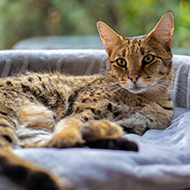
The statement highlights a number of welfare concerns.
A group of organisations dedicated to improving cat welfare has highlighted a number of concerns relating to the keeping of hybrid cats as pets.
The Cat Group, which includes Battersea, Blue Cross, BSAVA and International Cat care, has issued a position statement saying that it does not support the breeding of wild cat hybrids or the keeping of them as pets.
It is calling on the UK government to take immediate action, and to implement recommendations set out in the Animal Welfare Committee 2024 report to ban deliberate hybrid breeding and the import of domestic wild cat hybrids.
The statement reads: ‘Hybrid cats are being sold as pets, often promoted for their unique physical characteristics such as large size and wild-type coat patterns. There is growing evidence to suggest the breeding process raises ethical and welfare concerns for the individual cats involved.
‘Additionally, hybrid cats often experience poor welfare when kept as domestic pets, and owners may struggle with their cat’s undesirable behaviour.’
Hybrid cats are a cross between the domestic cat and wild cat species, with examples including the Chausie (bred from the jungle cat), the Savannah (bred from the Serval) and Bengal (bred from the Asian leopard cat). Many of these species are less than five generations removed from the wild cat, and are thought to be most susceptible to welfare problems when kept as pets.
Moreover, while the crossing of wild and domestic cat genes may produce a cat that is large and physically attractive, experts are apprehensive about the behaviour and temperament of these hybrids.
The statement continues: ‘For the safety of other cats and wildlife, hybrid cats often need to be confined in the home. However, this confinement is usually detrimental to the hybrid cat’s physical and emotional wellbeing.
‘A lack of research into the specific welfare needs of hybrid cats means that they are at risk of poor welfare when kept as pets, particularly around the need to exhibit normal behaviour and the need for suitable housing. This may lead to abandonment or relinquishment to shelters, many of which are ill-equipped to appropriately meet the environmental and behavioural needs of these cats.
‘As pets, hybrid cats may not see the vet as often as their domestic cat counterparts, and their unique nutritional needs are often not met appropriately.’
To read the statement in full, visit icatcare.org
Image (C) Shutterstock.


 Eligible members of BEVA will be able to vote for their Council team until Monday, 17 August 2026. Members will have received an election email on 17 July.



