


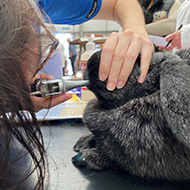
Research highlights the importance of diet, environment and dental checks.
There is no significant link between rabbit ear type or head shape and an increased risk of dental disease, according to new research.
The study by the Royal Veterinary College (RVC), funded in part by the Animal Welfare Foundation, concluded that diet, environment and regular dental checks might be more important in the development of dental problems.
Maria Jackson, research assistant in rabbit health and welfare, veterinary nurse, and lead author on the paper said: “Our findings add to the evidence that suggests lop ears and a brachycephalic head shape are less important in the development of dental issues in rabbits than was once thought. It’s clear that all rabbits, not just those with a non-wild conformation, can be affected by dental problems”.
In the study, researchers assessed tooth and mouth health of some 435 volunteered pedigree rabbits from 49 different breeds. Using an otoscope, the team recorded ear type, head shape, body size, age and sex.
They found that many of the rabbits had no obvious dental issues, with 62 per cent having no incisor abnormalities and 55 per cent experience no issues with cheek teeth. Lop-eared rabbits were not more likely to have dental issues, but were, however, four times more likely to have watery eyes, which could be liked to other health issues.
The study did find that longer-faced rabbits were slightly more likely (1.39 times) to have a specific dental issue known as “step or wave mouth”, and that male rabbits were two times more likely to have an incisor abnormality.
Researchers say their findings show the importance of vets, owners and breeders in undertaking routine dental checks and providing a nutritional diet.
Dr Jackson said: “The importance of feeding good-quality hay or grass and supplementing the diet with extruded pellets, not muesli, cannot be overstated, as diet may well be more important than conformation in the development of dental disease. Likewise, providing regular veterinary dental check-ups to rabbits is crucial to facilitate early dental disease detection and give case-specific dietary and treatment recommendations to slow disease progression and support the welfare of rabbits.”
Dr Charlotte Burn, associate professor in animal welfare and behaviour science at the RVC and co-author of the paper, added: “This research suggests that while rabbit conformation should not be entirely disregarded, it may not be as critical a factor for dental disease as previously thought. Encouragingly, this empowers rabbit owners and breeders to take proactive steps in promoting dental health through appropriate nutrition and husbandry, regardless of a rabbit’s breed or appearance.”
Image (C) Royal Veterinary College.


 Eligible members of BEVA will be able to vote for their Council team until Monday, 17 August 2026. Members will have received an election email on 17 July.



