


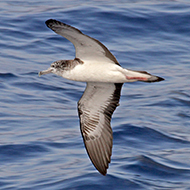
The habit may help to keep birds clean and fertilise coastal waters.
New research published in Current Biology has uncovered a surprising bathroom habit among seabirds in the open ocean.
The University of Tokyo-led study found that streaked shearwaters relieve themselves while flying, not while floating on water, and do so every four to 10 minutes.
It was an interesting turn of events for lead author Leo Uesaka, who originally set out to study how seabirds run on the sea's surface to take off.
He said: “While watching the video, I was surprised that they dropped faeces very frequently. I thought it was funny at first, but it turned out to be more interesting and important for marine ecology.”
Owing to their high mineral content, seabird droppings are a highly effective fertiliser for soil - and how they shape ecosystems on land has been well documented. However, far less is known about their impact on the ocean.
In the study, Uesaka strapped tiny cameras to the bellies of 15 streaked shearwaters and recorded some 200 defecation events. He noted that the birds almost always relieved themselves during flight and that it most often occurred after takeoff.
Interestingly, the birds sometimes took flight solely for a bathroom break, returning to the water within a minute. Uesaka notes this suggests that seabirds intentionally avoid going to the toilet while floating.
“Streaked shearwaters have very long and narrow wings, good for gliding, not flapping,” he said. “They have to flap their wings vigorously to take off, which exhausts them. This means the risk of excreting on the sea surface outweighs the effort to take off. There must be a strong reason behind that.”
The team believes the habit may prevent the birds from fouling their feathers with faces and help them to avoid predators. Another theory is that taking flight could help the birds defecate more easily, compared to a floating position.
Scientists plan to build on this work by mapping where seabirds release their droppings, offering further insights into the importance of seabird faeces for marine ecology.
Image (C) Shutterstock.


 Eligible members of BEVA will be able to vote for their Council team until Monday, 17 August 2026. Members will have received an election email on 17 July.



