


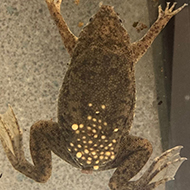
The species hatches from eggs in the mother’s back.
Four rare aquatic toads have been bred at Chester Zoo for the first time, as part of an international conservation breeding programme.
The Surinam toads, named Ripley, Lambert, Ash and Sallas from the Alien films, are now living in a specially created habitat in the zoo’s Tropical Realm.
Native to South America, the Surinam toad has a unique breeding process in which eggs are laid into the skin of the female’s back. The fertilised eggs are then pressed into the skin by the male.
Adam Bland, assistant team manager for amphibians at Chester Zoo, explains: “After implantation, the skin grows around these little white blobs in just a few hours. It’s a really quick process. The tadpoles form under her skin until they’re ready, and then they burst free and swim out from holes in her back".
The Surinam toad often sparks interest online for its links to trypophobia – an intense fear or disgust triggered by clusters of eggs or small holes. However, keepers have reassured visitors that the toads should be fine to view most of the time, as the eggs are only visible for a short period.
The species spends its entire life underwater and has a flattened body that helps them blend in with leaves on riverbeds. While the toads invest heavily into raising their young until hatching, they can pose a risk once the tadpoles emerge.
Mr Bland continued: “They’re extremely greedy and will eat almost anything that moves. We remove the tadpoles quickly to give them the best possible chance of survival.”
He added that working with unusual species like the Surinam toad helps improve understanding of amphibian biology at a time when many species are in decline.
“They aren’t animals people expect to see,” he said. “But that’s exactly why they’re so effective for helping people understand how amphibians live - and why we’re trying to prevent their extinction.”
Image (C) Chester Zoo.


 Eligible members of BEVA will be able to vote for their Council team until Monday, 17 August 2026. Members will have received an election email on 17 July.



